


Traditional approaches to managing nutrition for endurance training have previously placed an emphasis on high carbohydrate availability. This often means:
- Having a carb-rich meal or snack before training.
- Having carbohydrates during longer training sessions.
- Having a carb-rich post-training meal.
So what is this new ‘train low’ concept?
We have relatively small carbohydrate stores of around 300-900 grams in the muscle and 20-100 grams in the liver. The storage form of carbohydrates is called glycogen.
How much carbohydrates you store (your carbohydrate availability) depends on your diet. A higher carb diet will result in greater carb storage while a low carb diet would have the opposite effect.
Carbohydrates are used for efficient energy production. It theoretically makes sense to have a lot of carbs in and around endurance training sessions.
However, research in the sports nutrition world over the last decade has questioned this traditional approach. Maybe you can have too much of a good thing?
What Is Train Low, Compete High?
The concept of train low, and compete high deliberately reduces carbohydrate availability before and during training. Having low carbohydrate availability enhances endurance-training-induced metabolic adaptations of skeletal muscle.
However, carbohydrate availability is restored prior to an event or competition. This is so the athlete can perform at greater intensities for longer.
Research consistently shows that exercise with high carbohydrate availability improves acute exercise performance compared to exercising in a state of lower carbohydrate availability (i.e. fasted).
Therefore, ‘train low, compete high’ aims to achieve the best of both worlds. Training with low-carb availability enhances muscle adaptations, while high-carb availability on competition day optimises performance.
How To Train Low
There are several ways to train low.
Train low: Low Carbohydrate Diets
The first way to reduce carbohydrate availability is by following a low-carbohydrate diet. In this case, more energy would typically come from fat. This assumes that the reduction in carbohydrates is not also intended as a strategy for long-term weight or fat loss.
A low-carb, high-fat diet (LCHF) can be beneficial depending on the athlete, their training, and their goals. However, consistently following a low-carb diet may reduce the body’s ability to use carbohydrates as a fuel source. On competition day, this could hinder performance more than it helps.
So rather than being glycogen sparing, a LCHF diet in fact is glycogen impairing. This reduces its use in intense exercise, despite its availability in the muscle.
Burke et al. compared a LCHF diet to a diet with high carbohydrate availability amongst elite race walkers. They found that performance was impaired in the group following the LCHF diet over a three week period.
Outside of a low carbohydrate diet, there are many other ways to reduce carbohydrate storage. These other methods will allow you to have high carbohydrate availability sometimes and low carbohydrate availability other times.

Train Low: Sleep Low
Sleep low refers to training in the afternoon or evening and not consuming carbohydrates until after a training session the next morning.
This method has been used in research by Prof John Hawley and colleagues. This research found that the sleep low method may exaggerate some of the training adaptations.
Train Low: Training After An Overnight Fast
Training in the morning either fasted or after a low-carb meal or snack, is one of the easiest ways to train low.
By training after an overnight fast, the athlete would have lower liver glycogen stores but their muscle glycogen would remain unaffected.
Train Low: Training Twice Per Day
If you have two sessions in a day, you could complete the first one fuelled with pre-training carbohydrates. Then not include any during or post-training carbs.
This will mean you are starting your second session of the day with low carbohydrate availability.
Train Low: No Carbs During Recovery
No carbs during recovery is a method that can involve having high carbohydrate availability prior to training. Then following training, not immediately replenishing carbohydrate stores. This may also enhance training adaptations post-session.
Train Low: Long Training Session, No Carbs
A train low strategy that is often used by athletes who have a number of long training sessions per week is not including carbohydrates during training.
This strategy allows the athlete to start well fuelled with carbohydrates. They then deplete them over the course of a few hours and continue to train with low-carb availability.
As glycogen storage runs low and is not being replenished, additional stress needs to be applied to maintain intensity. It is this extra stress that may enhance adaptations to training.
However, this method will prevent an athlete from maintaining the intensity they could if they were fuelling during training. It is a trade-off.
There are so many ways to train low. Some methods reduce the availability of muscle glycogen, some only affect liver glycogen and others only limit exogenous (ingested carbohydrates).
Either way, most methods will affect training quality especially if muscle glycogen is heavily depleted.
When training low, you may also need longer recovery times between sessions.

The Glycogen Threshold Hypothesis
Current research suggests that it is actually the post-exercise glycogen availability that influences training adaptation.
This concept has been coined the “glycogen threshold hypothesis”.
The theory is that to maximise training adaptations, muscle glycogen should be below a particular threshold after exercise.
The most cited paper when talking about the glycogen threshold hypothesis is the 2018 article. It was titled “Fuel for the Work Required: A Theoretical Framework for Carbohydrate Periodization and the Glycogen Threshold Hypothesis”.
The authors of this paper proposed that glycogen concentration should be below the threshold of 300mmol/kg dry weight muscle after training. However, they should not be lower than 100mmol/kg as this may start to impair muscle protein synthesis.
Pre-exercise glycogen concentration, exercise intensity, exercise duration, and carbohydrate intake all influence glycogen usage during exercise. Selectively adjusting carbohydrate availability can help optimize adaptations while still allowing for optimal performance when needed.
This is also called “fuel for the work required”.
It basically means fuelling with enough carbohydrates to complete high-quality sessions. But not so much that post-training glycogen saturation exceeds the threshold for maximising training adaptations in the muscle.
The Difference Between “Train Low” & “Fuel For The Work Required”
Both of these methods of carbohydrate periodisation for endurance training are aiming to enhance training adaptations.
They do so by depleting glycogen to within a certain threshold and completing their training session with low carbohydrate availability.
The key difference is that “fuel for the work required” emphasises finding a balance. It supports fuelling for performance while ensuring time is spent within the glycogen threshold needed for optimal adaptations.
Whereas, some train low strategies will be done to the detriment of overall performance output.
Either way, an athlete using either one of these methods would be compromising performance in some training sessions, to some degree. However, fuel for the work required at least aims to minimise this.
Carbohydrate Periodization VS Low Carbohydrate Diets
Using a carbohydrate periodisation approach in contrast to an overall low carbohydrate approach is going to be a much better option.
Having a consistently low-carb diet will blunt one’s ability to efficiently use carbohydrates as a fuel source. This can limit performance in all training sessions.
A low carbohydrate diet would mean that an athlete could not practice their intra-training nutrition prior to race day too.
One big reason to consume intra-training carbohydrates is to ensure that an athlete is well prepared by the time their event rolls around.
If they are not able to practice, they will likely have a low tolerance to intra-training fuelling. To optimise carbohydrate intake during a long event, the gut needs to be trained to tolerate digestion whilst exercising. So including sessions regularly that involve optimal race day fuelling is crucial.

The Issue With Utilising “Fuel For The Work Required” As A Train Low Philosophy
The authors of that 2018 paper outlining this philosphy acknowledge that there is one glaring problem with this method.
You can’t actually quantify someone’s muscle glycogen levels easily.
We know that there is a wide range of variability in muscle glycogen usage between individuals.
Glycogen levels during their training also depend on intake leading up to the session and the glycogen cost of different types of training.
In order to use this method with accuracy, we need research to quantify the “glycogen cost” of different workouts. And also on how much individual variation there is in glycogen storage and usage.
Fuelling for the work required requires theoretical knowledge of glycogen usage within your specific sport. It also requires detailed assessments of previous food intake and training load. All of this is simply to formulate guidance for future training sessions.
Even for a well-trained sports dietitian, this could be quite difficult.
Does Training With Low-Carb Availability Actually Improve Performance?
Research in the train-low space is quite convincing when it comes to the adaptations that occur in the muscle.
In these types of studies, the key outcomes that are measured are:
- Cell signalling
- Gene expression
- Enzymatic changes in the muscle tissue
Over 70% of the research trials measuring these outcomes in relation to carbohydrate periodisation have produced positive outcomes.
However, such muscle adaptations do not always translate to improved exercise performance. For the studies measuring performance outcomes, only 37% showed an improvement. Whilst 63% resulted in no change to performance.
All of this research has been summarised here.
How To Incorporate The Train Low Concepts
The optimal way to incorporate train low or carbohydrate periodisation is not currently known. But you can still include the concepts as part of your overall nutrition plan.
You can do so by strategically adjusting carbohydrate intake before, during, and after training sessions.
For the most challenging sessions of your week or ones where you are expected to perform, it makes sense to consume plenty of carbs before and during these sessions.
Whilst lighter training sessions may be an opportunity to use a train low approach. To assist with performance in these sessions you may choose to use additional caffeine and carbohydrate mouth rinse.
The model below outlines a potential way to periodise carbohydrate intake for an elite endurance athlete (e.g. road cyclist) who trains once per day on 4 consecutive days where each session commences at 10:00 am each day.
Low, medium, and high refer to the level of carbohydrate in that meal.
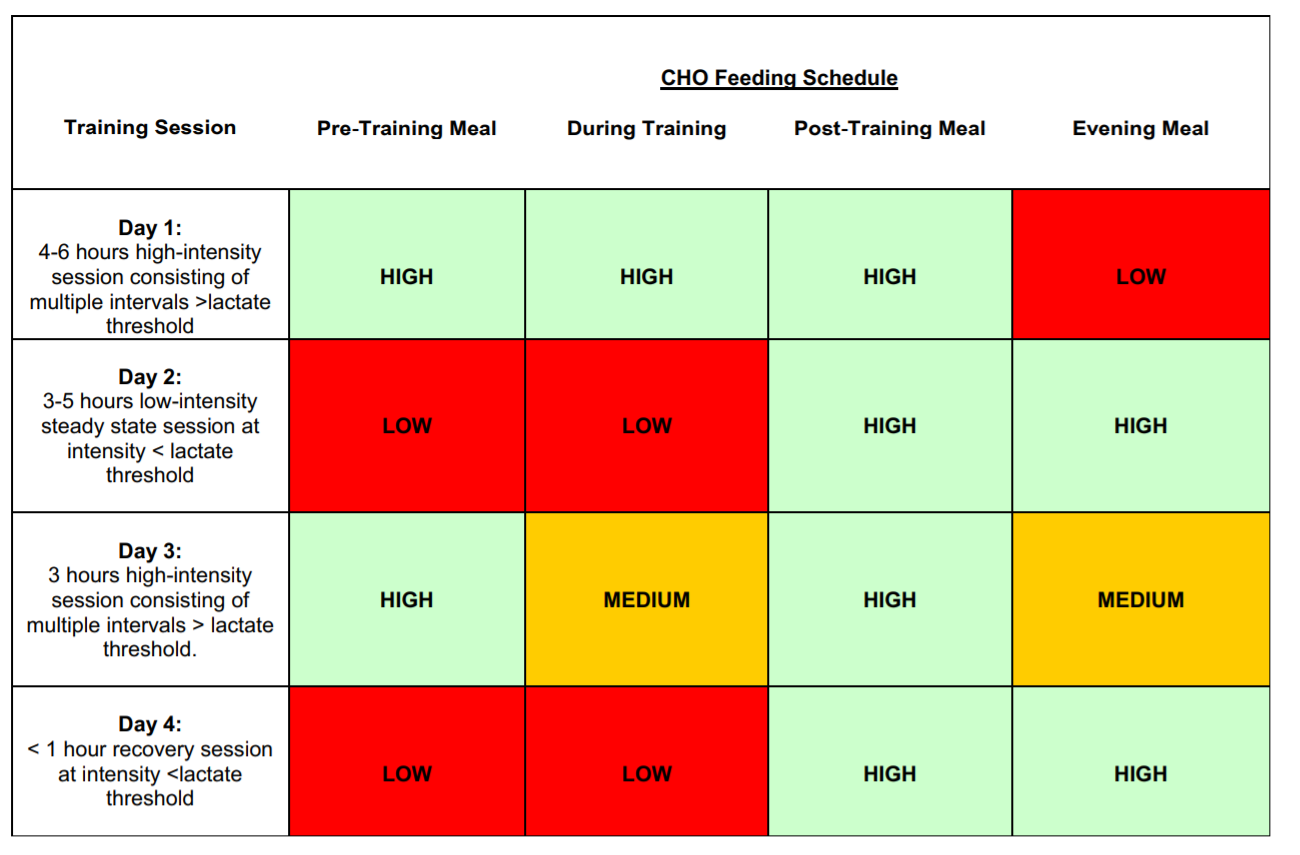
As you can see this athlete has sessions with both high and low carbohydrate availability. The train low sessions are their lower intensity sessions, whilst their intense sessions are well fuelled.
The athlete is also including one day of high carbohydrate availability during training. This gives them an opportunity to practice their race-day nutrition plan.
Summary
The concept of train low, compete high is still an emerging area of research.
It seems to have the potential for improving adaptations in training and potentially even improving performance in endurance athletes.
Ideally, a carbohydrate periodisation method would be used instead of an overall low-carb diet. This is so that the athlete is still able to metabolise carbohydrates efficiently. It also allows them to fuel harder training sessions optimally, and practice race-day nutrition.
But exactly how these methods are utilised is going to differ with each individual. It is dependent on their training and goals.
